

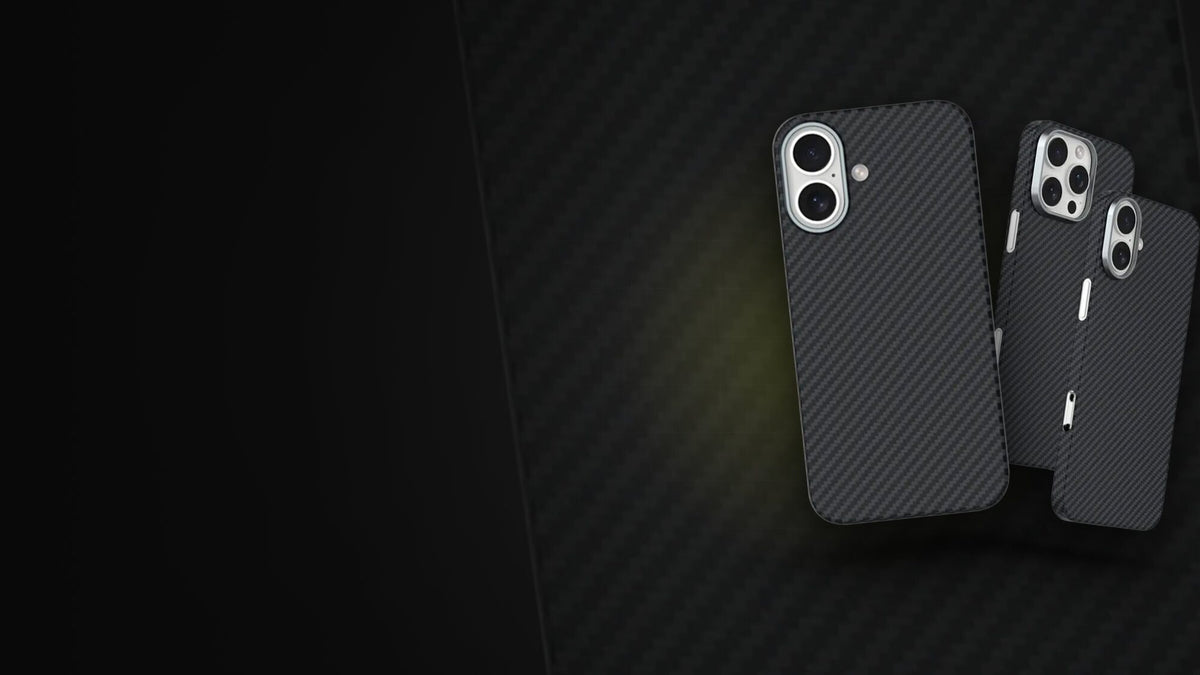
Aramid cases have a cult following for a reason: they're about as thin as a case gets, they feel rigid instead of rubbery, and the woven pattern looks expensive. They also get oversold. A Reddit thread titled "Aramid is not the material you want to protect against drops" ranks on the first page for this search, and it has a point.
An aramid fiber phone case is a thin, rigid shell made from woven aramid fiber, the family of synthetic fibers that includes DuPont's Kevlar, set in resin. Aramid is very strong for its weight, doesn't conduct electricity (so it doesn't block wireless charging or signal the way carbon fiber can), and resists scratches and scuffs well.
What it doesn't do is absorb big drops. A shell well under a millimeter thick is scratch and scuff armor, not a bumper. Buy one for thinness and feel, not for rugged protection.
What is an aramid fiber phone case?
Aramid is short for aromatic polyamide, a class of synthetic fibers made from long, rigid molecular chains that line up along the fiber. That alignment is what makes them so strong for their weight. The best-known aramid is Kevlar, invented by Stephanie Kwolek at DuPont in 1965 and commercialized in the early 1970s. Spun Kevlar fiber has a tensile strength around 3,000 MPa at a density of just 1.44 g/cm³, which is why it's in body armor, tires and aircraft parts.
A phone case uses that fiber as a woven fabric, soaked in resin and molded into a thin shell, then coated. The weave is what gives these cases their checkerboard or twill look. Because aramid itself breaks down under UV light, the resin and coating also protect the fibers from sunlight.
Aramid vs Kevlar: are they the same?
Kevlar is a brand of aramid. Specifically, it's DuPont's para-aramid. Other companies make para-aramids under their own names, so "aramid fiber case" and "Kevlar case" usually describe the same kind of product, and many listings use the words interchangeably. If a case says "Kevlar®," it's claiming DuPont's branded fiber; if it says "aramid," it may be DuPont's or another maker's. Performance in a thin phone shell is similar either way.
Aramid vs carbon fiber vs TPU: how they compare
Here's the part most listings blur. Many cases sold as "carbon fiber" are actually aramid, because real carbon fiber has a problem in a phone case: it's electrically conductive. A conductive layer over the phone's back can interfere with wireless charging and antennas. Aramid is an electrical insulator, so it doesn't have that issue, which is why aramid became the go-to material for thin premium cases.
Compare case materials side by side
Pick up to three. Density values are published material data; the other ratings are our 1 to 10 qualitative scores for a typical phone case made from each material, explained below the chart.
| Material | Density | Conducts electricity? | Typical case strength | Weak spot |
|---|---|---|---|---|
| Aramid (Kevlar) | 1.44 g/cm³ | No | Thin, rigid, scuff-proof | Little drop cushioning |
| Carbon fiber | ~1.8 g/cm³ | Yes | Very stiff | Can affect wireless charging and signal |
| TPU | ~1.2 g/cm³ | No | Absorbs impact | Thicker; clear TPU yellows |
| Polycarbonate | ~1.2 g/cm³ | No | Hard, cheap, clear | Scratches, can crack |
| Silicone | ~1.1 to 1.2 g/cm³ | No | Grippy, soft | Lint, oils, bulk |
Aramid density from Kevlar data (Wikipedia, DuPont technical guide); other densities are typical published ranges. Weight in the hand depends far more on thickness than on density, which is where aramid shells win.
Are aramid cases actually protective?
Against scratches, scuffs, keys in a pocket and the grit on a table: yes, very. Aramid composites are hard to cut and abrade, and the shell keeps the phone's back and frame looking new.
Against drops, be realistic. Drop protection mostly comes from material that can deform and absorb energy, like the thick TPU corners of a rugged case. A rigid shell about half a millimeter thick has almost no room to do that. It spreads a knock across the back, which helps with minor bumps, but on a hard corner drop onto concrete the phone takes most of the impact. That's the point the Reddit thread makes, and it's fair.
Kevlar stops bullets, so a Kevlar case must protect my phone like armor.
Body armor uses dozens of layers. A phone case uses one thin layer: excellent against scratches, modest against drops.
If drops are your main worry, a case with cushioned edges is the better choice; our military-grade drop test explainer covers what those ratings do and don't mean. If you want a thin case and a screen protector covers the glass, aramid is excellent.
What do 600D and 1500D mean?
The "D" is denier, a textile unit for how heavy a yarn is: the weight in grams of 9,000 meters of it. A 600D yarn is finer than a 1500D yarn, so 600D cases have a tighter, smaller weave pattern and 1500D cases show a bolder, larger pattern. It's mostly an aesthetic choice; both make thin, rigid shells.
Weave scale: finer yarn, smaller pattern
Illustration of pattern scale only.
Is an aramid case right for you?
Aramid, or something else?
Aramid cases, MagSafe, cleaning and yellowing
- MagSafe: aramid doesn't block wireless charging. Whether accessories hold depends on magnets built into the case; our Kevlar case is listed as MagSafe compatible. For the difference between "compatible" and "magnetic," see what a MagSafe case is.
- Cleaning: a damp microfiber cloth, a drop of dish soap for oily marks, then dry it. No solvents or scouring pads on the coating. Full details in our Kevlar case care guide.
- Yellowing: aramid shells are opaque and dark, so they don't show the tinting that ruins clear TPU. The fiber itself is UV-sensitive, which is one reason it's sealed in resin. More on why clear cases yellow in our clear case cleaning guide.
Our Kevlar case
We make one aramid case. It's for people who want the thinnest, most rigid shell we sell and are fine pairing it with a screen protector for drops. Sizes are limited right now; the selector shows what's in stock.

Aramid weave · 600D
Black Thin Kevlar® 600D Case
$49.00
- Fine 600D aramid weave, listed at 0.5 mm
- Listed as MagSafe compatible; charges through on MagSafe and Qi
- Rigid, scratch-resistant, no branding on the back
Free shipping. Want more drop cushion? The Rubberized MagSafe case below is the better pick.

Grippy surface, magnet ring built in, better for drops than a hard shell.
See the case
Thin shell with a 36+1 N52 magnet ring for grips and wallets.
See the caseThin, rigid, and honest about it.
The Black Thin Kevlar® case: 600D aramid weave, listed at 0.5 mm, $49 with free shipping.

Aramid fiber case FAQ
What is an aramid fiber phone case?
A thin, rigid case made from woven aramid fiber (the family that includes Kevlar) set in resin. It's light, very scratch-resistant and doesn't block wireless charging, but it's too thin to absorb big drops the way cushioned cases do.
Is aramid the same as Kevlar?
Kevlar is DuPont's brand of para-aramid fiber. "Aramid" is the general material class, so a Kevlar case is an aramid case, but not every aramid case uses DuPont's branded fiber. In a thin phone shell they perform similarly.
Is aramid better than carbon fiber for a phone case?
For most people, yes. Carbon fiber is electrically conductive and can interfere with wireless charging and antennas. Aramid is an insulator, so it doesn't. Many cases sold as "carbon fiber" are actually aramid for that reason.
Are Kevlar phone cases good for drop protection?
They're excellent against scratches and scuffs but modest against drops. A half-millimeter shell has little room to absorb impact. If drops are your main concern, choose a case with cushioned corners and use a screen protector.
What does 600D mean on an aramid case?
600D means the yarn weighs 600 grams per 9,000 meters (denier). It's finer than 1500D yarn, so the weave pattern looks tighter and smaller. It's mostly a visual difference.
Do aramid cases work with MagSafe?
Aramid doesn't block MagSafe or Qi charging. Whether MagSafe accessories stick depends on whether the case has magnets built in, so check the listing for a magnet ring rather than just "MagSafe compatible."
Do aramid cases turn yellow?
They don't show yellowing like clear TPU because they're opaque and sealed in resin. The fibers themselves are sensitive to UV, which is why they're coated rather than left exposed.
How do I clean a Kevlar phone case?
Wipe it with a damp microfiber cloth, add a drop of dish soap for oily marks, and dry it. Avoid solvents and abrasive pads that can dull the coating.
Keep reading
Troy BaconTroy runs GripLux, an accessory brand owned by Global Trading Partners LLC (ownership details). GripLux sells an aramid case, so we've tried hard to be clear about what it won't do.
Sources
- Wikipedia, Kevlar (para-aramid; Kwolek, DuPont 1965; ~3,000 MPa tensile strength; density 1.44; UV degradation).
- DuPont, Kevlar Aramid Fiber Technical Guide.
- Wikipedia, Carbon fibers (electrical conductivity, density).
- Wikipedia, Aramid (aromatic polyamides).
- Reddit r/GalaxyFold, "Aramid is not the material you want to protect against drops".
Share:
What Does MagSafe Mean? How MagSafe Works on iPhone, Explained Simply