

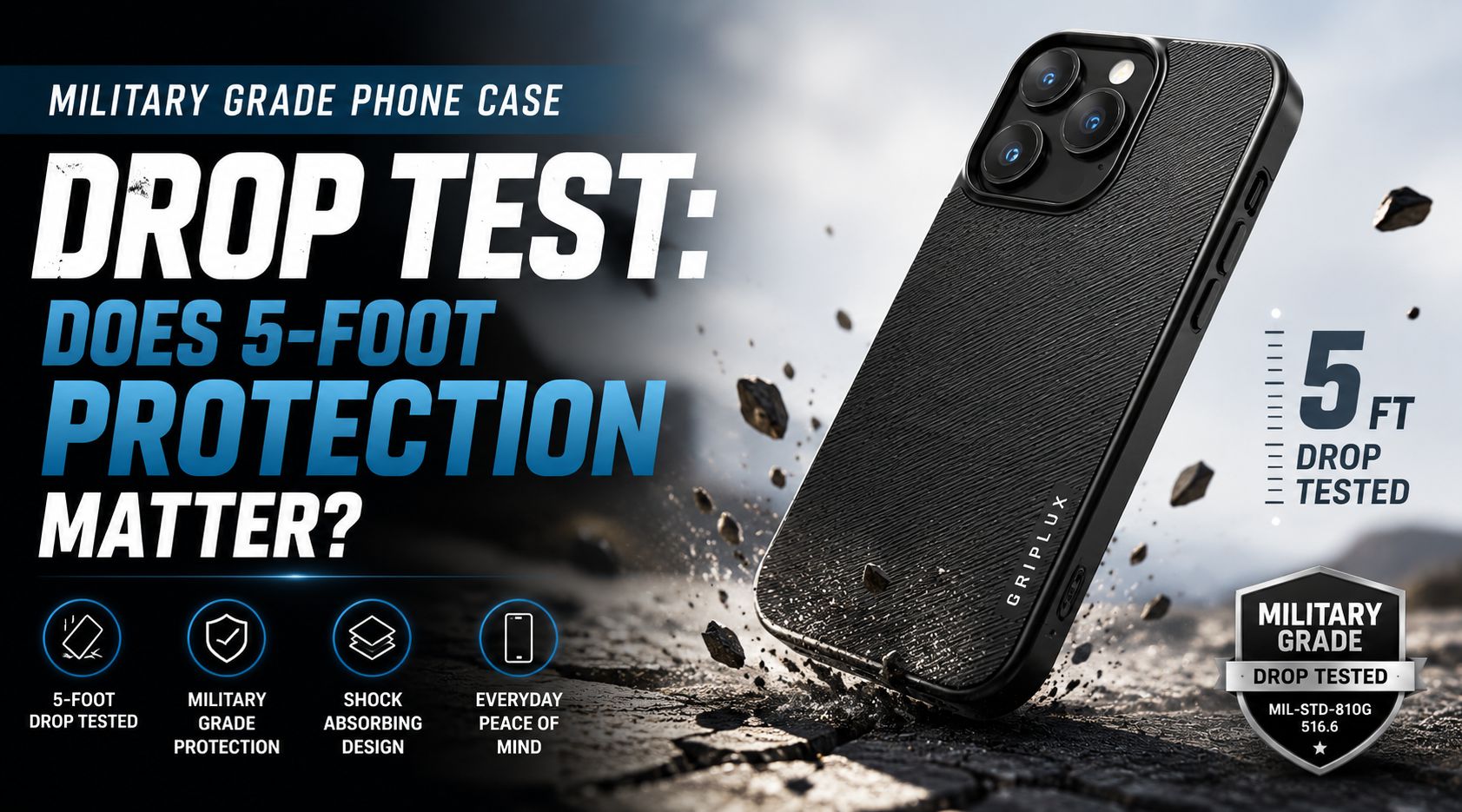
If you've spent any time on phone-accessory TikTok lately, you've seen the format: someone holds a phone up, drops it from shoulder height onto concrete, and the case takes the hit while the screen stays perfect. Drop-test videos have become one of the most reliable ways a phone case goes viral - and searches for "military grade" and "drop protection" phone cases have followed right along with the trend.
The catch is that most of those viral clips don't explain what the ratings actually mean, or what material is doing the work. So before you trust a case with your $1,000 phone, here's what's really behind the drop-test hype - and how the Griplux Thin Kevlar 600D Case stacks up.
What "Military-Grade" Actually Means
"Military-grade" gets used loosely in phone case marketing, but the reference point is a real U.S. Department of Defense testing standard (MIL-STD-810G) that involves repeated drops from a set height onto plywood over concrete. A case that "exceeds military-grade standards" is being held to a higher bar than that baseline test - more drops, or a greater height, without the phone taking damage.
The number that actually matters to you as a buyer is the drop height rating - how far the case is built to protect your phone from before you'd expect damage.
How Phone Cases Are Drop Tested
Most reputable manufacturers test phone cases by dropping them multiple times from different angles - flat, edge, and corner impacts - rather than a single perfect drop. These repeated, multi-angle tests are designed to simulate the kind of accidents that actually happen in daily life: a phone slipping off a couch arm, sliding out of a pocket, or catching a corner on the way down. Testing methods vary by brand, but repeated impact testing at multiple angles gives a far better indication of real-world protection than a single viral drop clip ever could.
Why Kevlar Specifically
Most viral drop-test cases lean on thick rubber or silicone to absorb impact, which works, but adds bulk. Kevlar (technically aramid fiber) takes a different approach. It's the same fiber family used in body armor and aerospace parts, valued for being extremely strong relative to how little it weighs. That's what allows a Kevlar-backed case to offer serious impact resistance without turning your phone into a brick.
It also has a side benefit that pure rubber cases don't: aramid fiber doesn't interfere with wireless signal or MagSafe charging, so you're not trading durability for convenience.
The Griplux Thin Kevlar 600D Case
Griplux's Kevlar case is built from 600D DuPont™ Kevlar fiber - "600D" refers to the denier (thread thickness) of the weave, and a 600D construction is denser and smoother than lower-grade aramid weaves, which is part of why the case stays slim.
- Drop protection rated to 5 feet, exceeding standard military-grade testing
- 600D DuPont™ Kevlar fiber construction - no interference with MagSafe, 5G, or wireless signal
- Full MagSafe compatibility with a built-in magnet ring
- Precision cutouts for ports, buttons, and camera access
- No visible branding - a clean, minimal black finish
- 4.7/5 average customer rating
- $49.00
The water-, fingerprint-, and oil-resistant coating is worth calling out on its own: it's what keeps the case looking clean and matte months in, instead of turning greasy or smudged the way untreated cases often do.
Kevlar vs. Standard Silicone: A Quick Comparison
| Feature | Standard Silicone Case | Griplux Kevlar 600D |
|---|---|---|
| Bulk | Medium | Slim |
| Drop protection | Good | Better (5-ft rated) |
| MagSafe support | Varies by brand | Full support |
| Yellowing over time | Can happen | Doesn't yellow |
| Signal interference | Rare | None (non-conductive fiber) |
| Material | Rubber/TPU | 600D DuPont™ Kevlar |
Is It Worth the Higher Price?
At $49, the Kevlar case costs more than Griplux's standard MagSafe or Ultra Thin lines. The difference comes down to what you're paying for: the standard lines prioritize slimness and style, while the Kevlar case prioritizes surviving the kind of drop that would crack a screen through a regular case. If you've cracked a phone before, or you're rough on your devices day-to-day (construction, delivery driving, active jobs, kids), the extra cost buys real peace of mind. If you're mostly desk-to-couch with your phone, one of Griplux's slimmer lines will serve you just as well for less.
Frequently Asked Questions
Does "5-foot drop protection" mean the case is indestructible?
No case can guarantee zero risk in every scenario - surface, angle, and impact point all matter. A 5-foot rating means the case is built and tested to protect against drops from that height under standard conditions.
Will a Kevlar case interfere with wireless charging or 5G signal?
No. Aramid fiber is non-conductive, so it doesn't block wireless charging, MagSafe, 5G, GPS, or NFC the way some metal or carbon-fiber cases can.
Is Kevlar heavier than a regular silicone case?
Not necessarily - Kevlar's strength-to-weight ratio is part of why it's used in body armor. The Griplux Kevlar case stays slim despite the added protection.
Does the case turn yellow or degrade over time like clear cases do?
No. Aramid fiber doesn't yellow with UV exposure the way clear TPU cases often do.
While viral drop-test videos can be entertaining, real protection comes from quality materials and thoughtful engineering - not just a dramatic slow-motion clip. If a case is going to protect your phone, it needs to hold up long after the camera stops rolling.
Looking for something slimmer or more colorful? Browse our full MagSafe Cases and Ultra Thin Cases collections, or see the complete iPhone case lineup.
Aktie:
Griplux Luxi Snap Grip vs LoveHandle MagSafe Pro: Which #griptok Favorite Actually Wins?
Griplux Ultra Thin Case Review: Worth It in 2026?