

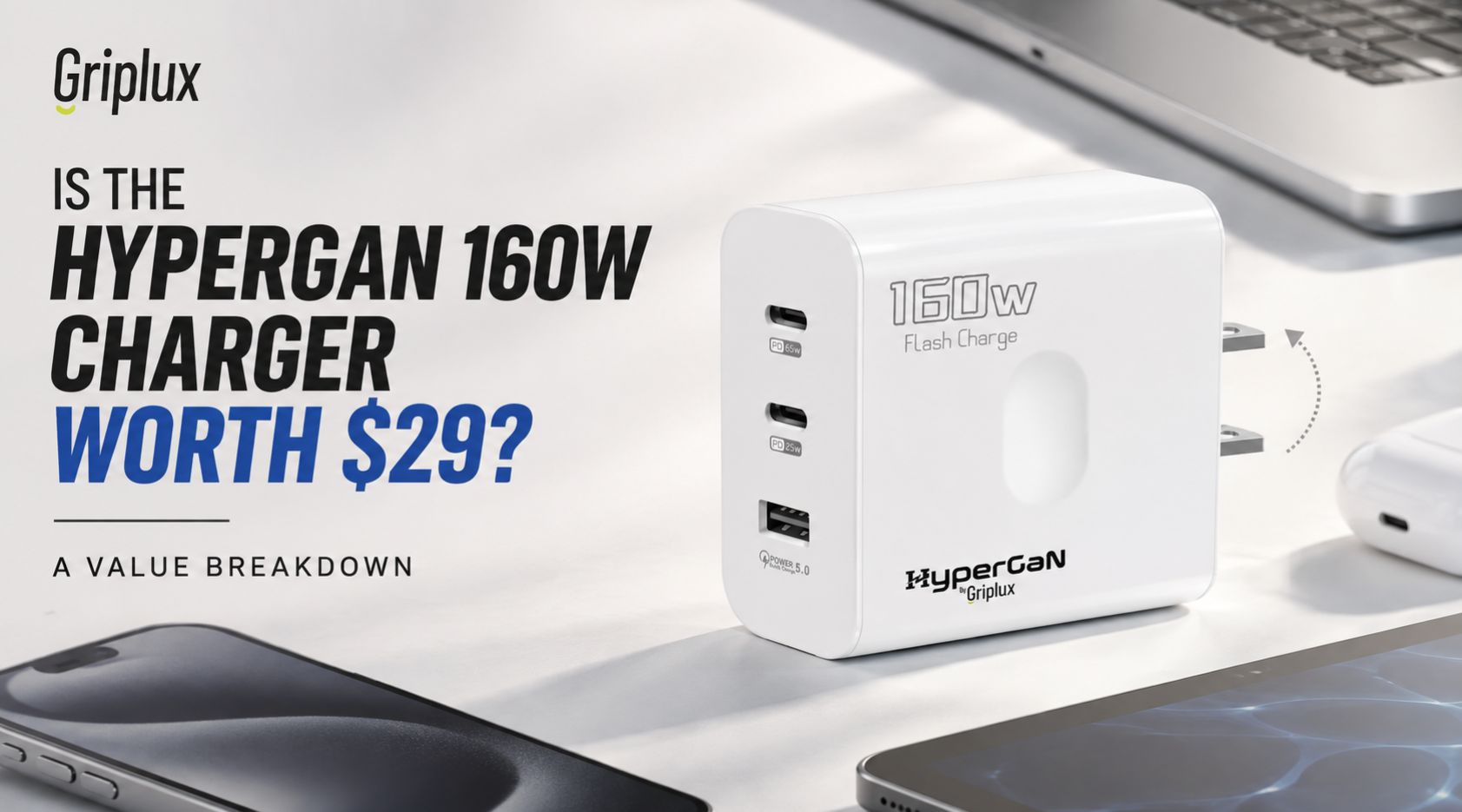
A charger listed at $78 and selling for $29 is the kind of discount that makes people suspicious rather than excited. Steep markdowns on electronics usually mean one of two things: the product is genuinely discounted to move inventory, or the original price was inflated to begin with. The only way to actually answer the hypergan charger value question is to look at what the specs deliver against what similar chargers cost elsewhere, not just trust the percentage off.
Quick answer: At $29, the HyperGaN 160W Charger delivers strong value for anyone charging more than one device at a time. Comparable 4-port GaN chargers from established brands typically sell in the $50 to $70 range even without a discount, which puts the HyperGaN's price well below the category average for its power output and port count.
What You're Actually Paying For
Before judging whether $29 is a good price, it helps to know exactly what that price includes. The HyperGaN 160W Charger offers:
-
160W total output across four ports, three USB-C and one USB-A
-
Smart power allocation, automatically adjusting output per device rather than splitting power evenly regardless of need
-
GaN semiconductor design, allowing a smaller physical footprint than an equivalent silicon charger
-
Enough power to charge a phone, tablet, and laptop simultaneously from a single outlet
That combination, high wattage, multiple ports, and smart allocation, is what typically pushes charger prices into premium territory from bigger brands.
Comparing the Price Against the Category
Multi-port GaN chargers with similar specs from well known brands commonly retail between $50 and $70 at full price, and rarely drop much below $40 even during sales events. A single-port 65W to 100W GaN charger from a recognizable brand alone often costs $30 to $50, meaning the HyperGaN's four ports and 160W output at $29 is priced closer to what competitors charge for a single-port charger with a fraction of the capability.
This is the core of the hypergan charger value question. It is not just about the discount percentage, it is about where the sale price lands relative to what comparable multi-port, high-wattage chargers cost across the market.
Where the Value Actually Comes From
The real value of a charger like this shows up when you count how many separate chargers it replaces. A typical household or desk setup might involve a phone charger, a tablet charger, and a laptop charger, often three separate purchases totaling more than $29 combined even at budget pricing. Consolidating that into one charger saves both money and outlet space, which is where the practical value goes beyond the sticker price comparison.
A Real Example of the Math
Say you were shopping separately: a basic 20W phone charger for around $15, a 30W tablet charger for around $20, and a 65W laptop charger for around $35. That is roughly $70 spent across three separate chargers, each doing one job and taking up its own outlet. The HyperGaN 160W Charger at $29 replaces all three functions in a single unit, at less than half the combined cost of buying them separately.
That comparison is where the value proposition holds up best, not just against other single multi-port chargers, but against the realistic alternative of buying multiple separate chargers to cover the same devices.
Is There a Catch?
It is fair to be skeptical of any steep discount, so it is worth addressing directly. A $78 to $29 markdown is a real reduction based on the pricing structure, not a fake inflated discount with no basis, since the underlying specs (160W, GaN design, four ports, smart allocation) are consistent with what similarly specced chargers cost elsewhere before any sale pricing. The honest caveat is that "regular price" markers on any product should always be taken as a reference point rather than a guarantee, and pricing on any item can change over time.
Value Beyond the Purchase Price
A charger's real cost is not just what you pay upfront, it includes how long it lasts and how well it protects the devices plugged into it. GaN chargers run cooler than older silicon designs at the same wattage, which reduces the heat-related wear that shortens a charger's usable life over time. Smart power allocation also plays a role here, since a charger that properly negotiates power with each connected device puts less strain on both the charger and the device's battery compared to a charger that simply pushes maximum output regardless of what is plugged in.
None of this shows up on the price tag, but it factors into whether $29 represents good value over the charger's full lifespan, not just its first month of use. A charger that needs replacing within a year because of heat damage or component wear is a worse value than one that lasts several years, even if the second one costs more upfront.
Who Gets the Most Value From This Charger
-
Anyone charging multiple devices daily, since the per-device cost drops the more ports actually get used
-
People short on outlet space, particularly in dorms, shared apartments, or small home offices
-
Frequent travelers who want to consolidate multiple chargers into one item for a bag
-
Anyone who currently owns three or more mismatched chargers and wants to simplify
Who Might Not Need It
If you only ever charge a single phone and never plug in a second device at the same time, a smaller single-port charger will do the job for less money and less desk space. The 160W output and four ports are the entire value proposition here, and that value only shows up if you are actually using more than one port regularly.
Frequently Asked Questions
Is the HyperGaN 160W Charger actually worth $29?
Yes, for anyone charging more than one device regularly. Comparable 4-port GaN chargers from other brands typically cost $50 to $70 at full price, making $29 a strong value for the specs offered.
Why is the HyperGaN charger discounted from $78 to $29?
The listed discount reflects the difference between the charger's regular price and its current sale price. The underlying specs, 160W output, four ports, and GaN design, are consistent with chargers priced similarly to the $78 mark elsewhere in the market.
Does a cheaper charger mean lower quality?
Not necessarily. Price differences between chargers often come down to brand markup and marketing rather than a proportional difference in components, especially once a charger meets baseline safety certifications.
Is 160W overkill for most people?
It depends on how many devices you charge at once. For a single phone, yes, it is more power than necessary. For a phone, tablet, and laptop charging together, 160W split across four ports is a practical, not excessive, amount of power.
How does the HyperGaN compare to buying separate chargers?
Buying a phone charger, tablet charger, and laptop charger separately often costs more in total than the HyperGaN's single sale price, while also taking up more outlet space and adding more cables to manage.
Does the HyperGaN charger work with non-Apple devices?
Yes. USB-C and USB-A charging ports are universal standards, so the charger works with Android phones, tablets, laptops, and any other device that charges through those port types, not just Apple products.
The Bottom Line
The hypergan charger value question comes down to a straightforward comparison: at $29, this charger is priced below what similarly specced multi-port GaN chargers cost elsewhere, and it replaces the practical need for two or three separate chargers in most households or desk setups. It is not the right purchase for someone who only ever charges one device at a time, but for anyone juggling multiple devices from a single outlet, the price reflects genuine value rather than an inflated discount with nothing behind it.
Check out the HyperGaN 160W Charger to see current pricing and availability.
Aktie:
Frosted White Ultra Thin Case Review
Solid Black MagSafe Thin Magnetic Case: Full Review