

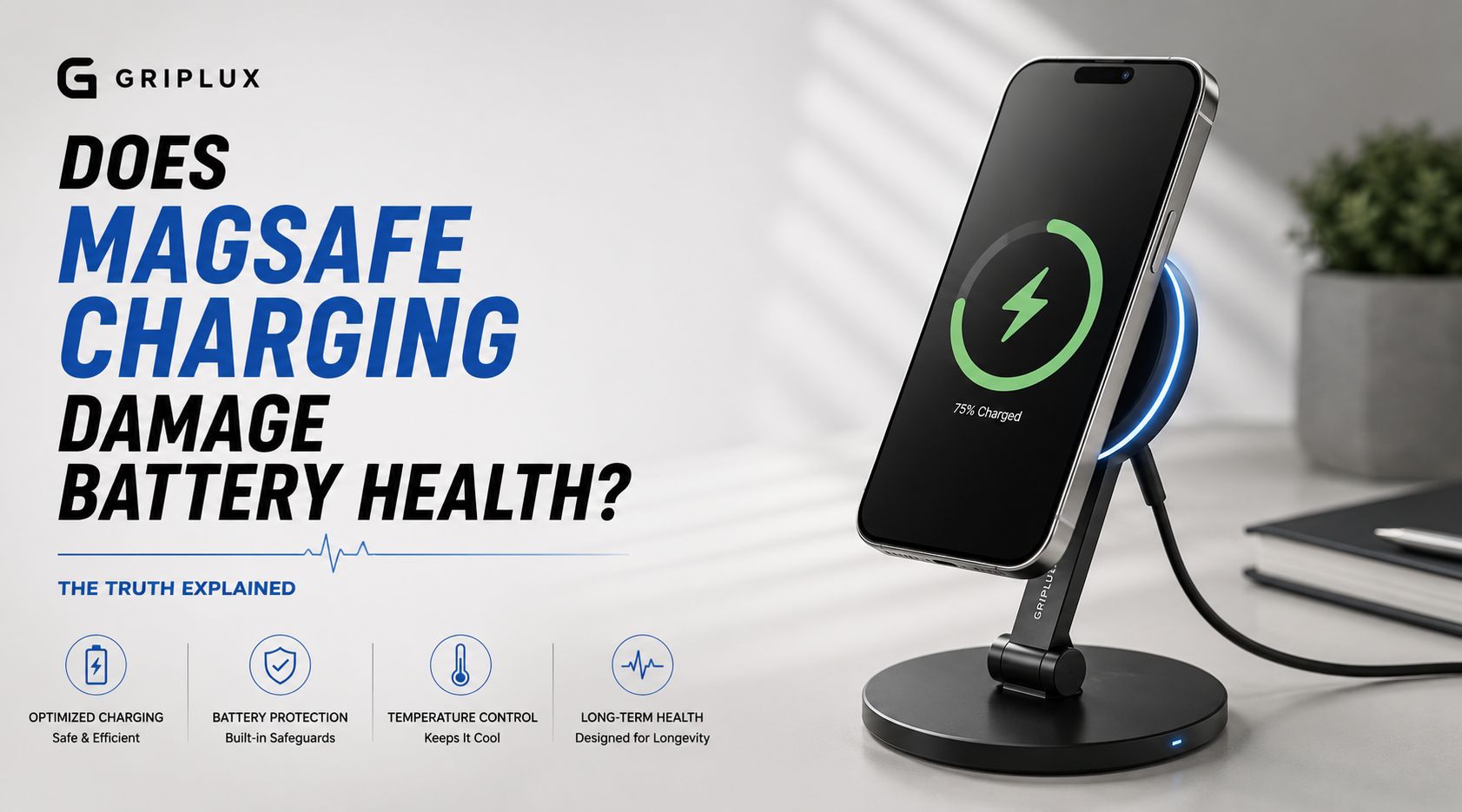
Somewhere along the way, "wireless charging kills your battery faster" turned into one of those things everyone half-believes without really knowing why. It's not entirely made up - there's a real mechanism behind the concern — but the actual answer is more nuanced than a flat yes or no, and it matters if you're deciding whether to stick with a cable or go all-in on MagSafe.
Where the Concern Actually Comes From
Every phone battery is a lithium-ion battery, and lithium-ion batteries share one consistent weakness: heat. Repeated exposure to high temperatures accelerates the chemical wear that happens inside a battery over time, which is why a phone that runs hot regularly tends to lose maximum capacity faster than one that stays cool.
Wireless charging, including MagSafe, generates more heat than a cable does. That's simply how the technology works - power transfers through an electromagnetic field between the charger and the coil inside your phone, and that transfer isn't perfectly efficient. Some energy is lost as heat during the process, more than you'd get from a direct wired connection. That's the entire basis for the "MagSafe is bad for your battery" concern, and it's a real, physical effect, not a myth.
Why It's Not as Simple as "Wireless Is Bad"
Here's the part that gets left out of most conversations about this: modern phones are built with battery management systems specifically designed to work around this heat difference. Charging speed automatically throttles down if the phone senses it's getting too warm, and most phones stop charging altogether at 100% rather than trickle-charging in a way that keeps the battery under constant strain.
MagSafe specifically was engineered with this in mind. The magnetic alignment isn't just about convenience - keeping the charging coils perfectly lined up (instead of the loose alignment you get with a generic wireless pad) makes the power transfer more efficient, which means less wasted energy turning into heat compared to a non-aligned wireless charger. That's a meaningful difference between MagSafe and a cheap wireless charging pad, even though both are technically "wireless."
What Actually Impacts Battery Health More Than Charging Method
If you're trying to protect your battery long-term, the charging method you use is one factor among several, and usually not the biggest one. Charging habits that matter more include:
-
Keeping your phone at very high or very low charge for extended periods — batteries degrade faster sitting at 100% for hours than they do during the charge itself
-
Charging in direct sunlight or a hot car, where ambient heat compounds whatever heat the charging process generates
-
Using a case that traps heat against the phone's back panel during charging, rather than one that allows some airflow
-
Fast-charging habitually from very low battery, which generates more heat than a slower, steady charge
That last point is where charger quality matters. A well-designed charger with smart power delivery - like the HyperGaN 160W Charger - adjusts its output based on what the device actually needs rather than pushing maximum power regardless of the situation, which reduces unnecessary heat generation compared to a poorly regulated charger.
Does the Case You Use Matter?
Somewhat, yes. A solid, non-ventilated case can trap heat against the phone during wireless charging, on top of the heat the charging process already generates. If you tend to wireless charge overnight or for long stretches during the day, a case designed with airflow in mind — like Griplux's Thin Heat Dissipation Case - reduces one contributing factor, even though it's not solving heat generation at the charging-coil level itself.
A Simple, Practical Approach
None of this means you need to avoid MagSafe or wireless charging altogether. A few habits go further than switching charging methods entirely:
-
Avoid letting your phone sit at 100% on a charger for hours longer than necessary
-
Take the phone off the charger if it feels noticeably warm to the touch
-
Avoid charging in direct sunlight or a hot car
-
Choose a charger with proper power regulation rather than a cheap, unbranded option
The Bottom Line
MagSafe charging does generate more heat than a wired connection, and heat is genuinely the main driver of battery wear over time - that part of the concern is accurate. But MagSafe's precise magnetic alignment makes it meaningfully more efficient than a generic wireless pad, and modern phones are built with safeguards that limit how much that heat actually affects the battery during normal use. The bigger factors in long-term battery health are charging habits and heat exposure overall, not simply whether a cable is plugged in or not.
Frequently Asked Questions
Does MagSafe charge slower to protect the battery?
MagSafe's charging speed is generally lower than a wired fast-charge connection, partly due to the nature of wireless power transfer and partly as a built-in safeguard against excess heat buildup.
Is it bad to leave my phone on a MagSafe charger overnight?
Modern phones stop charging once they hit 100% rather than continuously trickle-charging, so occasional overnight charging isn't a major concern. Doing it every night for years is more relevant to long-term wear than any single overnight session.
Does a phone case affect wireless charging efficiency?
Very thick or metal-containing cases can interfere with charging efficiency and generate extra heat. Thin, MagSafe-compatible cases are designed specifically to avoid this issue.
Is wired charging always better for battery health than MagSafe?
Wired charging generates less heat, which is generally gentler on the battery long-term, but the difference is smaller than people often assume, especially with a well-aligned charger like MagSafe compared to a generic wireless pad.
How can I tell if my battery health is declining?
Most phones include a built-in battery health setting that shows maximum capacity compared to when the phone was new. A noticeable drop, combined with the phone struggling to hold a charge through the day, are the clearest signs.
MagSafe doesn't significantly harm battery health on its own. In most cases, long-term battery life depends far more on heat, charging habits, and the quality of the accessories you use.
If you use MagSafe every day, your accessories matter just as much as your charging habits. Browse Griplux's collection of MagSafe-compatible cases and chargers designed to work seamlessly together—so you can charge with confidence every day.
Aktie:
MagSafe Grip vs PopSocket: Which Is Better in 2026?
How to Choose a Durable Phone Case