

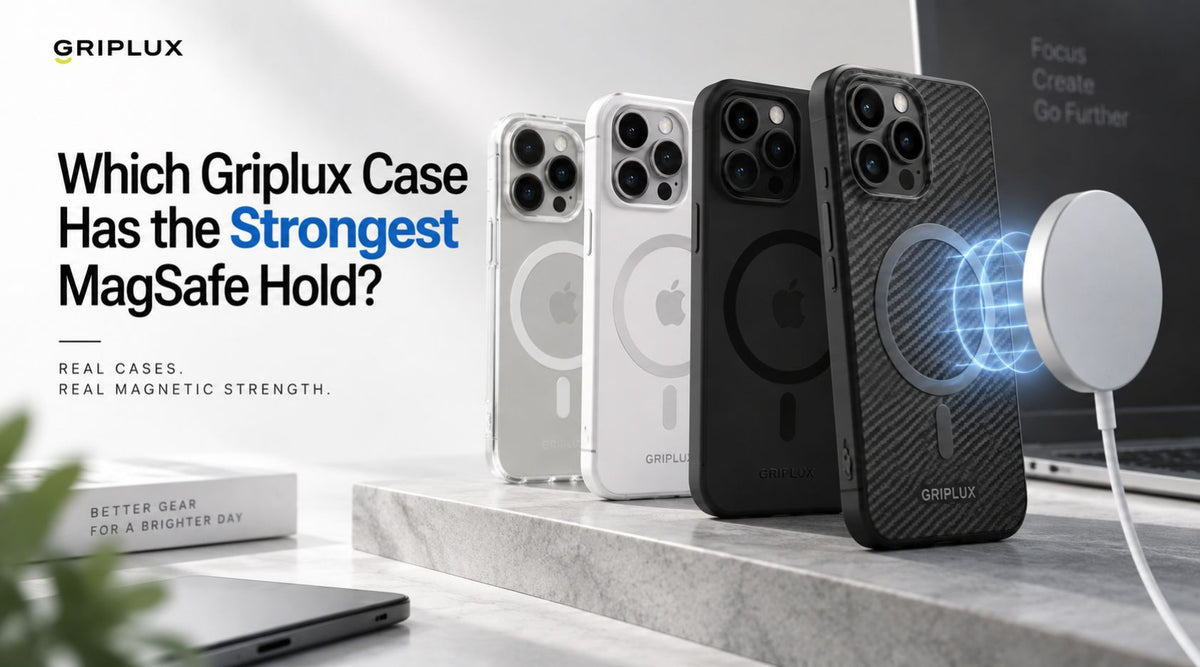
Not every MagSafe case holds accessories with the same force, even within the same brand. Griplux sells several distinct case lines, and they are not built around identical magnet configurations. If you rely heavily on MagSafe chargers, car mounts, wallets, or grips, the strongest magsafe case in the lineup is not necessarily the one you would guess by looks alone.
Quick answer: Among Griplux's case lines, the MagSafe Rubberized Case uses the strongest magnet configuration at 36+2 N52 magnets, edging out the MagSafe Thin Magnetic Case's 36+1 setup. The Ultra Thin and Kevlar lines use a standard integrated MagSafe magnet ring without the higher magnet count marketed on the other two lines. For most accessory use, all four hold securely, but the Rubberized case is built with the strongest hold as a specific design priority.
Why Magnet Configuration Actually Matters
MagSafe hold strength depends on two main factors: the grade of magnet used and how many individual magnets make up the ring array. Griplux uses N52 neodymium magnets across its dedicated magnetic case lines, a high grade on the standard neodymium strength scale. Beyond grade, magnet count matters too, since more individual magnets contributing to the connection generally means a firmer, more evenly distributed hold across the case's surface, rather than concentrated strength in just a few points.
This is why two cases can both say "MagSafe compatible" and still perform differently in practice. Compatibility means the case works with MagSafe accessories at all. Hold strength is a separate spec describing how firmly it holds them.
Comparing Magnet Configuration Across Griplux's Case Lines
-
MagSafe Rubberized Case: 36+2 N52 magnets, the highest count in Griplux's lineup, built into a 1.2mm soft-touch silicone shell
-
MagSafe Thin Magnetic Case: 36+1 N52 magnets, in a 0.6mm food-grade PP shell
-
Ultra Thin Case: standard integrated MagSafe magnet ring, at 3.5mm, without a marketed high-count magnet array
-
Thin Kevlar 600D Case: standard integrated MagSafe magnet ring, built into reinforced aramid fiber construction
For a full breakdown of how the Thin Magnetic and Ultra Thin lines compare beyond just magnet strength, see our MagSafe Thin Magnetic vs Ultra Thin comparison.
The two magnetic-focused lines, Rubberized and Thin Magnetic, are specifically engineered around magnet count as a core selling point. The Ultra Thin and Kevlar lines prioritize other things first, slimness for one, drop protection for the other, while still including full MagSafe functionality.
Why the Rubberized Case Edges Out the Thin Magnetic Case
The difference between 36+2 and 36+1 magnets is small in raw count, but it reflects a deliberate design choice. The Rubberized case is built with real estate to work with at 1.2mm, compared to the Thin Magnetic case's ultra-slim 0.6mm profile, and that extra thickness allows for a slightly larger magnetic surface area. In practical terms, this means the Rubberized case holds heavier MagSafe accessories, like a mounted car charger or a larger power bank, with marginally more confidence than the thinner case, though both perform reliably for typical daily accessories like chargers, grips, and wallets.
Does Case Thickness Affect Magnet Strength?
Generally, yes, though not in the direction people assume. A thicker case does not automatically mean a stronger magnetic connection, since MagSafe magnets need to be close enough to your phone's internal magnet array to maintain proper alignment. What thickness actually enables is more physical space for a larger magnet array, which is part of why the Rubberized case at 1.2mm supports a higher magnet count than the ultra-thin 0.6mm case. Beyond a certain thickness, though, added material can begin to weaken the connection by increasing the distance between the case's magnets and whatever accessory is attaching to it.
What "Strongest" Actually Means for Daily Use
It is worth being clear about what a stronger magnet configuration changes in practice, since the difference is not dramatic for typical daily use. All four Griplux case lines securely hold standard MagSafe accessories, chargers, the Luxi Snap Grip, wallets, and most mounts, without issue. The practical difference between 36+1 and 36+2 magnets, or a standard ring versus either configuration, shows up more in edge cases: heavier accessories, active use where the phone is bumped or jostled frequently, or mounting situations like a car dash where a firm connection matters more than usual.
A Real Scenario Worth Considering
Picture someone who mounts their phone to a car dashboard daily using a MagSafe car mount, then also occasionally attaches a MagSafe wallet or a portable battery pack on top of that. In that kind of layered, heavier accessory use, the Rubberized case's 36+2 configuration provides a bit more margin against the connection loosening over bumps and vibration. Compare that to someone who mostly uses MagSafe for overnight wireless charging and the occasional grip, where any of the four case lines would perform the job without a noticeable difference.
The stronger magnet count matters most when you are stacking accessories or relying on the connection in situations involving movement, not for the average day of charging and casual use.
How to Judge Magnet Strength Beyond the Spec Sheet
Magnet count and grade are useful numbers, but they are not the only way to gauge real-world hold strength. A simple, practical test is attaching your heaviest MagSafe accessory, a wallet with several cards, a larger battery pack, or a car mount, and gently shaking the phone or tapping the back of the case. A properly aligned, strong magnetic connection should hold firm through normal movement without any noticeable shift. If an accessory slides or wobbles under light shaking, that is a more telling real-world signal than the printed magnet count alone.
It is also worth checking alignment specifically, not just strength. A case with a slightly misaligned magnet ring can feel weaker than its actual magnet grade would suggest, since even strong magnets lose effectiveness if they are not centered properly against the accessory's magnet array. Griplux holds consistent ring diameter and pole spacing across its case lines specifically to avoid this kind of alignment-related weakness.
Buying Based on Your Actual MagSafe Habits
Rather than defaulting to the case with the highest magnet count, it helps to think through how you actually use MagSafe day to day. Someone who primarily uses MagSafe for overnight charging and the occasional grip has little practical reason to prioritize the Rubberized case's extra magnet count over a slimmer option they would prefer to carry daily. Someone who mounts their phone in a car, attaches a battery pack during long days out, or uses MagSafe accessories in situations involving movement and vibration has a much clearer case for prioritizing the strongest available configuration.
This is the difference between a spec that looks impressive on paper and a spec that actually changes your day to day experience. Matching the case to your real habits, rather than simply choosing the highest number, tends to produce a better outcome than optimizing for magnet count in isolation.
Comparison Table
|
Case Line |
Magnet Configuration |
Thickness |
Priority |
|---|---|---|---|
|
MagSafe Rubberized |
36+2 N52 |
1.2mm |
Maximum magnet strength |
|
MagSafe Thin Magnetic |
36+1 N52 |
0.6mm |
Extreme thinness with strong hold |
|
Ultra Thin |
Standard MagSafe ring |
3.5mm |
Everyday slimness |
|
Thin Kevlar 600D |
Standard MagSafe ring |
Reinforced |
Drop protection |
Does a Stronger Magnet Affect Wireless Charging Speed?
No, not directly. Charging speed depends primarily on your iPhone model, the charger's wattage, and the power adapter feeding it, not the case's magnet count. A stronger magnetic connection helps keep the charger properly aligned during use, which indirectly supports consistent charging, but it does not increase the maximum wattage a case can deliver.
Choosing Based on Magnet Strength vs Other Priorities
Magnet strength is one factor among several, and it should not be the only one driving your decision. If MagSafe accessory security is genuinely your top priority, whether for car mounting, content creation rigs, or frequent accessory swapping, the Rubberized case's 36+2 configuration is the strongest choice in Griplux's lineup. If thinness matters more than maximizing magnet count, the Thin Magnetic case still offers a notably strong 36+1 setup in a much slimmer package. If drop protection or minimal everyday bulk are the priority instead, the Kevlar or Ultra Thin lines deliver full MagSafe functionality without being built specifically around maximum hold strength.
Frequently Asked Questions
Which Griplux case has the strongest MagSafe magnets?
The MagSafe Rubberized Case has the strongest configuration in Griplux's lineup, using 36+2 N52 magnets, compared to the Thin Magnetic case's 36+1 setup and the standard MagSafe ring used in the Ultra Thin and Kevlar lines.
Does a stronger magnet configuration mean faster wireless charging?
No. Charging speed depends on your iPhone model, the charger's wattage, and the power adapter, not the case's magnet strength. A strong connection helps maintain proper charger alignment but does not increase charging speed on its own.
Is the difference between 36+1 and 36+2 magnets noticeable in daily use?
For typical daily use, chargers, grips, and light accessories, the difference is minor. It becomes more relevant with heavier accessories or active use situations like car mounting, where a firmer hold provides more margin against the connection loosening.
Do thinner cases have weaker MagSafe magnets?
Not necessarily weaker, but thinner cases generally have less physical space for a larger magnet array. Griplux's Thin Magnetic case still uses a strong 36+1 N52 configuration despite its 0.6mm profile.
Does the Kevlar case have a weaker magnetic hold than the other case lines?
The Kevlar case uses a standard integrated MagSafe magnet ring rather than the higher magnet counts marketed on the Rubberized or Thin Magnetic lines, but it still provides reliable MagSafe functionality for typical accessory use.
Should I choose a case based on magnet strength alone?
Only if MagSafe accessory security is your top priority, such as frequent car mounting or heavier accessory use. For most buyers, thickness preference, drop protection needs, and overall case priorities matter as much or more than maximizing magnet count.
Can I test magnet strength myself before committing to daily use?
Yes. Attaching your heaviest regular MagSafe accessory and gently testing it under light movement gives a practical sense of hold strength beyond the spec sheet, and checking alignment is just as important as raw magnet count.
Will a stronger magnet configuration wear out or weaken over time?
Neodymium magnets like the N52 grade used in Griplux's cases are known for retaining their strength over long periods with normal use, and magnetic degradation from everyday handling is generally minimal compared to other wear factors like the case's material or coating.
The Bottom Line
Among Griplux's case lineup, the MagSafe Rubberized Case delivers the strongest MagSafe hold thanks to its 36+2 N52 magnet configuration, with the Thin Magnetic case close behind at 36+1 magnets in a notably slimmer package. The Ultra Thin and Kevlar lines use a standard MagSafe ring and still perform reliably for everyday accessory use, just without the higher magnet count built specifically around maximum hold strength. For most buyers, any of the four will handle daily MagSafe use without issue, and the right choice comes down to whether magnet strength or another priority, thinness, protection, or grip feel, matters most to you.
Whichever line you choose, it helps to remember that Griplux maintains consistent ring diameter, pole spacing, and pull force tolerances across its entire case lineup, which is part of why even the standard-configuration lines still deliver a dependable connection rather than a noticeably weaker one. The gap between "strongest" and "standard" within Griplux's own lineup is a matter of degree, not a difference between a case that works well and one that does not.
Compare the full Griplux case lineup to find the right balance of magnet strength and everyday priorities for your phone. If you are also considering a MagSafe grip alongside your case, our Luxi Snap Grip vs LoveHandle comparison covers magnet performance on the grip side as well.
Share:
Black vs White Luxi Snap Grip: Which Color Should You Buy?
What's the Best Griplux Case and Grip Combo?