

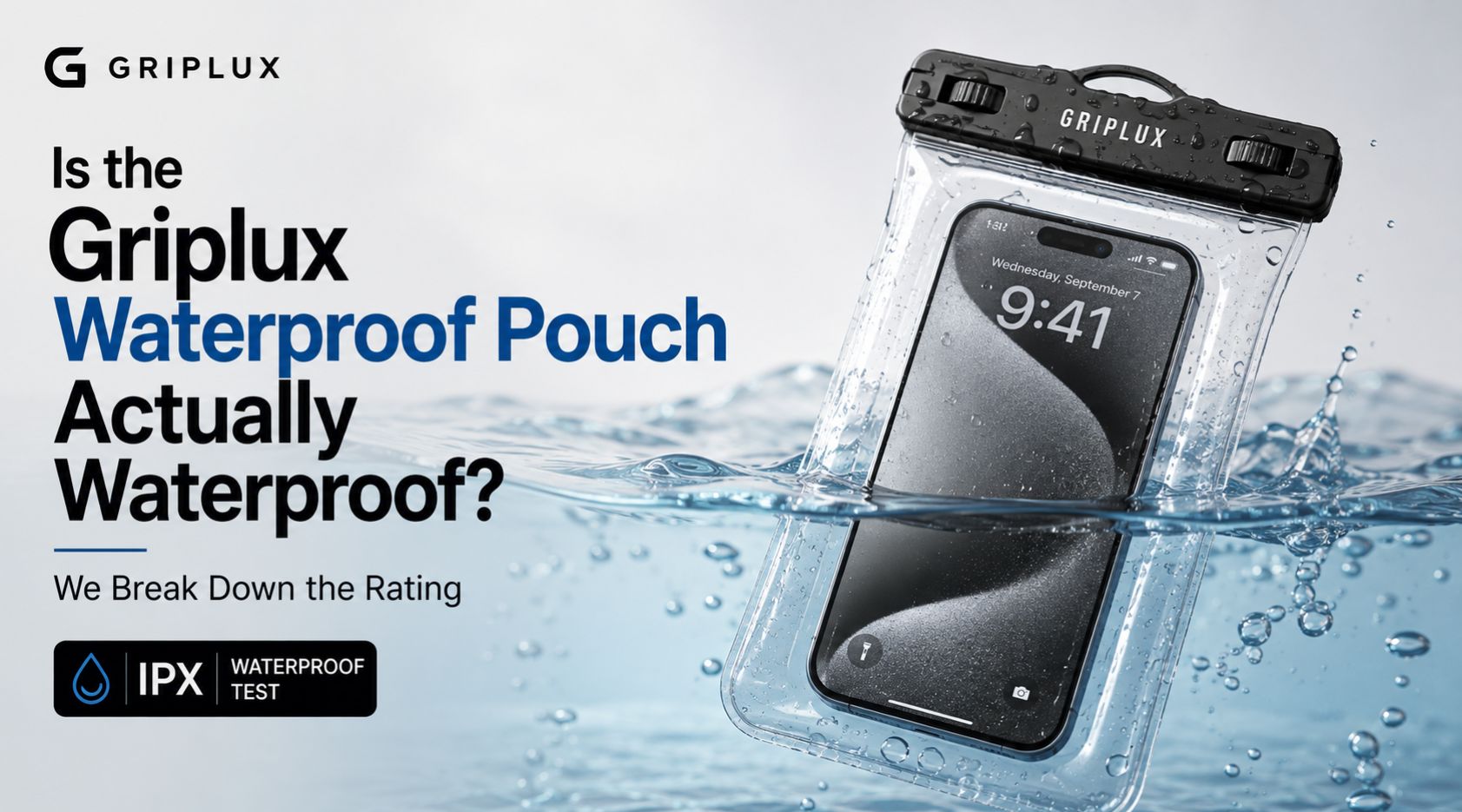
You are standing at the edge of a pool with your phone in a pouch someone told you was waterproof, and you are not fully convinced. That hesitation is fair. "Waterproof" gets printed on a lot of products that only survive a light splash, so it is worth actually understanding what a rating like IPX8 promises before you trust it with your phone.
Quick answer: Yes, the Griplux Waterproof Floating Phone Pouch is genuinely waterproof, rated IPX8, which is the highest tier of everyday water resistance ratings. That means it is built to handle full submersion, not just splashes or rain, as long as it is sealed correctly before use.
What IPX8 Actually Means
IPX8 comes from the IP (Ingress Protection) rating system, an international standard used to grade how well a product resists dust and water. The first character after "IP" covers dust resistance, and since this pouch is rated with an X in that spot, it means dust resistance was not separately tested. The second number, the 8, is the part that matters here: it is the highest standard rating for liquid protection, and it specifically covers continuous submersion in water beyond one meter deep.
For context, a rating like IPX4 only promises resistance to splashing water from any direction. IPX7 covers submersion up to one meter for about 30 minutes. IPX8 goes further, and manufacturers are allowed to specify their own tested depth and duration beyond that one meter baseline, since the standard itself does not cap it at a single fixed number.
Why the Rating Alone Does Not Tell the Whole Story
Here is the part that trips people up. An IPX8 rating describes what the material and seal are capable of under controlled test conditions, not a guarantee that covers every possible real world scenario. A pouch can be rated IPX8 and still let water in if the seal is not closed properly, if it develops a crack or puncture over time, or if it is used well beyond its tested depth or duration.
This is not a knock against the rating itself. It just means the number tells you what the product is engineered for, while how you actually use it determines whether you get that protection in practice.
How the Griplux Pouch Is Built
The pouch is made from TPU material (thermoplastic polyurethane), a flexible, durable plastic commonly used in waterproof gear because it holds a seal well while still being clear enough to see and use a touchscreen through. A few practical details from the product specs:
-
IPX8 waterproof rating
-
Exterior dimensions: 9.5 x 5.0 inches
-
Interior space: fits devices up to 6.8 inches
-
Weight: 0.2 lbs (90 grams), light enough to float rather than drag a phone down
-
Universal compatibility with iPhone, Samsung, Huawei, Xiaomi, and Oppo devices
-
$29.99
A Real-World Example
Picture two people using the same pouch on the same beach day. One seals it carefully, presses out the air, checks the closure twice, and takes it into the water for photos. The other tosses their phone in, folds the top over once without checking the seal, and jumps in the pool.
Both are using an IPX8 rated pouch. Only one of them is actually getting the protection that rating promises. The material and the seal design can only do their job if the seal is engaged correctly every time, which is true of essentially every waterproof pouch on the market, not just this one.
How This Compares to Other Water Ratings You Might See
|
Rating |
What It Covers |
|---|---|
|
IPX4 |
Splashing water from any direction, not submersion |
|
IPX7 |
Submersion up to 1 meter for about 30 minutes |
|
IPX8 |
Continuous submersion beyond 1 meter, duration set by the manufacturer |
Common Mistakes That Cause Waterproof Pouches to Fail
Most waterproof pouch failures are not a defect in the product itself. They come down to a handful of avoidable mistakes:
-
Not fully closing the seal. A pouch relies on a complete, even seal along the entire closure line. Missing even a small section at the corner can let water in gradually.
-
Trapping a sharp object inside. Keys, coins, or a phone with a cracked screen edge can puncture the material from the inside without an obvious sign of damage until it is too late.
-
Ignoring wear over time. A pouch used weekly for a full summer season is not the same as a brand new one. Seals and material both wear down gradually with repeated folding, sun exposure, and friction.
-
Assuming "waterproof" means "indestructible." A rating protects against water ingress specifically. It does not mean the pouch can withstand being crushed, punctured, or dropped from a height onto a hard surface.
Where This Pouch Actually Gets Used
The IPX8 rating matters most in specific situations, and knowing which ones helps set the right expectations. Swimming and snorkeling are the most obvious uses, where the phone stays submerged for extended stretches. Kayaking, paddleboarding, and boating fall into a slightly different category: the phone is not always underwater, but a sudden splash, a dropped paddle, or a capsized kayak can put it there without warning, and an IPX8 rated pouch is built for exactly that kind of unplanned submersion.
Hiking and camping in wet weather is a lower-intensity use case, closer to protecting against rain and stream crossings than full submersion, but the same rating comfortably covers that lighter use with room to spare. Beach days sit somewhere in between, protecting against sand, splashes, and the occasional accidental drop into shallow water.
Tips for Getting the Full Protection
-
Do a dry test first. Seal the pouch with a piece of tissue or paper towel inside, submerge it briefly in a sink, and check if the paper stayed dry before trusting it with your actual phone.
-
Press the air out before sealing. Trapped air can put pressure on the seal and make it easier for water to work its way in over time.
-
Check the seal edge for debris. Sand or small particles caught in the closure are one of the most common reasons a waterproof pouch fails in practice.
-
Do not exceed the practical depth for casual use. Even with an IPX8 rating, treating the pouch gently and avoiding unnecessary depth or pressure extends its reliability.
Frequently Asked Questions
Is IPX8 better than IPX7?
Yes. IPX7 covers submersion up to about 1 meter for roughly 30 minutes, while IPX8 covers submersion beyond that depth, with the exact tested depth and duration set by the manufacturer.
Can I take photos and use the touchscreen while the phone is in the pouch?
Yes, the TPU material is designed to be touchscreen responsive, so you can use your phone normally while it stays sealed inside.
How do I know if the pouch's seal is still good after repeated use?
Run the dry paper towel test periodically, especially after the pouch has been in a bag with sharp objects or used frequently, since repeated folding and sealing can wear down the closure over time.
Will the pouch protect my phone at the bottom of a pool?
It is rated for submersion, but repeatedly diving to greater depths or leaving it submerged for extended periods increases risk. For casual swimming, snorkeling, and water sports, it performs as intended.
Does IPX8 mean the pouch is also dustproof?
Not necessarily. The IPX8 rating specifically addresses water resistance. The pouch does offer general protection from sand and dust in practical use, but that is separate from the formal water rating.
Do waterproof pouch ratings expire or wear out over time?
The rating itself describes the product when new, but real-world performance can decline as the material and seal age. A pouch that has been used heavily for a season, exposed to sun, or folded repeatedly is not guaranteed to perform exactly like it did on day one, which is why periodic testing with the dry paper towel method is worth doing rather than assuming the original rating holds forever.
The Bottom Line
The Griplux Waterproof Floating Phone Pouch's IPX8 rating is real and it is the top tier of everyday water protection, but a rating is only half the equation. The other half is using it correctly every single time: sealing it fully, checking the closure, and not treating the number as a guarantee that removes the need for basic care.
Ready to try it for yourself? Check out the Waterproof Floating Phone Pouch before your next trip to the water.
Share:
Sierra Blue Ultra Thin Case Review
Frosted White Ultra Thin Case Review