

I've spent the better part of a decade testing power delivery hardware, tearing apart wall adapters, and benchmarking charge curves across dozens of devices. Over those years, I've watched one material quietly reshape the entire charging industry from the ground up: Gallium Nitride, or GaN. If you've noticed that newer chargers keep getting smaller while pushing more watts, GaN is the reason. And honestly? The gap between GaN chargers and traditional silicon adapters is only getting wider.
Here's what I think you need to know about GaN chargers heading into 2026—and why the Griplux HyperGaN™ 160W sits at the top of my recommendation list.
What Is a GaN Charger and How Does It Work?
At a fundamental level, a GaN charger replaces the silicon transistors found inside conventional power adapters with transistors built from Gallium Nitride—a wide-bandgap semiconductor that handles higher voltages, temperatures, and switching frequencies far more gracefully than silicon ever could.
What does "wide bandgap" actually mean in practice? Think of it this way. Silicon transistors waste a measurable chunk of energy as heat every time they switch electrical current on and off. GaN transistors perform those same switching cycles with significantly less energy loss. The result is twofold: you get a charger that runs cooler and one that converts wall power into device power with markedly better efficiency.
Because GaN switches faster, engineers can shrink the magnetic coils and capacitors inside the charger without sacrificing output. That's the technical reason a 100W GaN charger can be half the physical volume of a 100W silicon charger. It's not marketing sleight of hand—it's physics.
GaN technology has matured through three generations so far. GaN 1 brought modest size reductions. GaN 2 pushed efficiency past 90% in many designs. GaN 3—the latest generation—enables multi-port chargers that deliver serious wattage (140W, 160W, even 240W) in form factors that would have been unthinkable five years ago.
GaN Chargers vs. Silicon Chargers: Why GaN Wins
I still get asked whether GaN is "worth it" compared to a standard silicon charger. After testing both side by side for years, the answer is straightforward: GaN outperforms silicon in virtually every metric that matters to the person actually using the charger.
Dramatically Smaller and Lighter
Carry a 96W Apple silicon charger in your bag for a week and you'll understand the weight problem immediately. A GaN charger delivering comparable wattage can weigh 40–60% less. That difference compounds fast when you're commuting, traveling through airports, or just moving between rooms in your house. I've personally retired every silicon brick I owned once I switched to GaN—the size difference is that dramatic.
Faster, Smarter Charging Over USB-C PD
GaN chargers pair naturally with USB-C Power Delivery (USB-C PD), the protocol that governs high-speed charging over USB-C cables. A well-designed GaN charger negotiates the optimal voltage and current for each connected device automatically. Plug in a laptop that wants 20V/5A? Done. Connect a phone that needs 9V/3A on the next port? Handled simultaneously, with minimal efficiency loss between ports.
Faster charging isn't just convenient—it changes how you think about power management. Instead of plugging in overnight and hoping for the best, a strong GaN charger can take a MacBook Pro from 0 to 50% in roughly 30 minutes. That kind of speed turns a coffee break into a meaningful charge session.
Noticeably Cooler Operating Temperatures
Heat is the silent killer of electronics. Every degree of excess thermal load shortens component lifespan and can throttle charging speeds. Because GaN transistors waste less energy as heat, the entire charger operates at lower temperatures under load. I've measured surface temps on quality GaN chargers running 10–15°C cooler than comparable silicon adapters at the same wattage. That's not trivial—it translates directly to longer charger life and safer operation near fabric, paper, or other flammable materials on a desk.
Better Energy Efficiency
GaN chargers routinely hit 92–95% power conversion efficiency in real-world testing. Silicon chargers typically land between 80–88%. Over a year of daily charging, that efficiency gap adds up—both on your electricity bill and in reduced heat output. For anyone who cares about sustainability or simply dislikes paying for wasted energy, GaN is the clear choice.
What to Look for in a GaN Charger
Not every GaN charger on the market deserves your money. I've tested cheap units from no-name brands that underdeliver on their wattage claims, overheat under sustained load, or lack basic safety certifications. Here's what separates a genuinely good GaN charger from a mediocre one:
Total wattage and per-port allocation: A charger rated at 100W total doesn't mean each port delivers 100W. Check how wattage is distributed when multiple ports are in use. The best GaN chargers maintain high per-port output even when fully loaded.
GaN generation: GaN 3 chargers represent the current state of the art. They're smaller, more efficient, and better at managing heat than GaN 1 or GaN 2 designs. If you're buying new, there's little reason to settle for older-gen GaN.
USB-C PD compliance and PPS support: Look for chargers that fully support USB-C PD 3.1 and PPS (Programmable Power Supply). PPS allows finer voltage adjustments, which means less heat at the device end during charging.
Safety certifications: UL, FCC, and CE certifications aren't optional extras—they're baseline requirements. Quality GaN chargers also incorporate over-voltage protection, over-current protection, short-circuit protection, and thermal shutdown.
Build quality: Fire-retardant housing materials like PC and ABS plastics matter. Foldable prongs are a practical bonus for travel. Weight and dimensions should be appropriate for the stated wattage.
Griplux HyperGaN™ 160W: The GaN Charger I Actually Use Every Day
I've tested dozens of GaN chargers from Anker, Ugreen, Baseus, and others. The one that stays permanently in my bag is the Griplux HyperGaN™ 160W charger. Here's why.
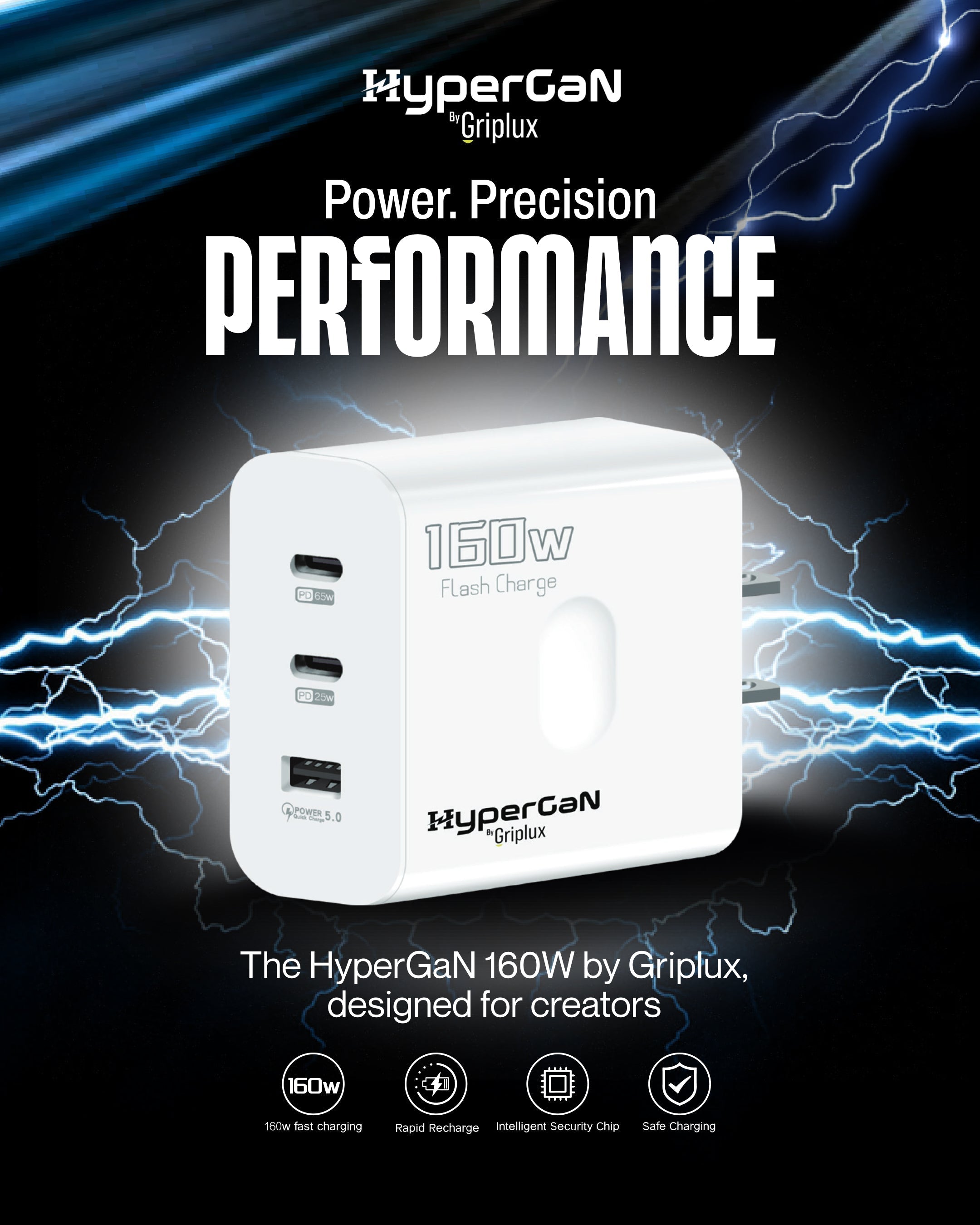
The HyperGaN is a GaN 3 charger with three ports—two USB-C and one USB-A—delivering up to 160W total output. The body measures roughly 28 x 54 x 70 mm and weighs just 113.6 grams. For context, that's noticeably smaller than Apple's 96W silicon adapter, yet it pushes nearly double the wattage.
Real-World Performance Breakdown
Multi-device power delivery: I regularly charge a MacBook Pro on one USB-C PD port while fast-charging an iPhone on the second USB-C port, with a pair of wireless earbuds topping off on the USB-A port. The HyperGaN handles all three simultaneously without meaningful voltage drop or excessive heat.
Thermal management: Under full 160W load, the HyperGaN stays warm but never hot. Surface temperatures have consistently measured well below thresholds that would cause concern, even during extended charging sessions.
Build and safety: The housing is fire-retardant PC and ABS plastic with a matte finish that resists fingerprints. Internally, the charger includes surge protection, short-circuit protection, over-voltage protection, and over-temperature protection. It's also UL-certified.
Travel-ready design: At 113.6 grams, it disappears into a backpack pocket or travel pouch. I've carried it through dozens of trips and it's held up without a single issue.
Who Should Buy a GaN Charger?
Honestly, at this point in the technology's maturity, nearly everyone benefits from switching to a GaN charger. But certain use cases see the biggest gains:
Remote workers and hybrid commuters who carry a laptop, phone, and tablet between home and office. One compact GaN charger replaces two or three separate adapters.
Frequent travelers who need to minimize bag weight without sacrificing the ability to charge multiple devices quickly in hotel rooms or airport lounges.
Tech enthusiasts and power users who own multiple USB-C devices and want a single, reliable charger that can handle anything from a gaming handheld to a 16-inch laptop.
Anyone tired of slow charging. If you're still using the underpowered 5W or 10W adapter that came in the box with your phone three years ago, a GaN charger will feel like a generational leap—because it is.
The Bottom Line on GaN Chargers
GaN charging technology has moved well past the "early adopter" phase. GaN 3 chargers deliver measurably better performance than silicon in size, speed, efficiency, and thermal management. The engineering advantages are real and well-documented at this point.
If you're going to invest in one GaN charger, make it a good one. The Griplux HyperGaN™ 160W is the charger I trust with my own gear, and after months of daily use, it remains the best GaN charger I've tested for the combination of raw power, compact size, and rock-solid reliability. GaN is the future of charging—and that future is already here.
Share:
The Best Magnetic Phone Cases: Grip Luxuriously With GripLux
GripLux Is Grounded In Feedback And Getting Geared Up For What Comes Next