

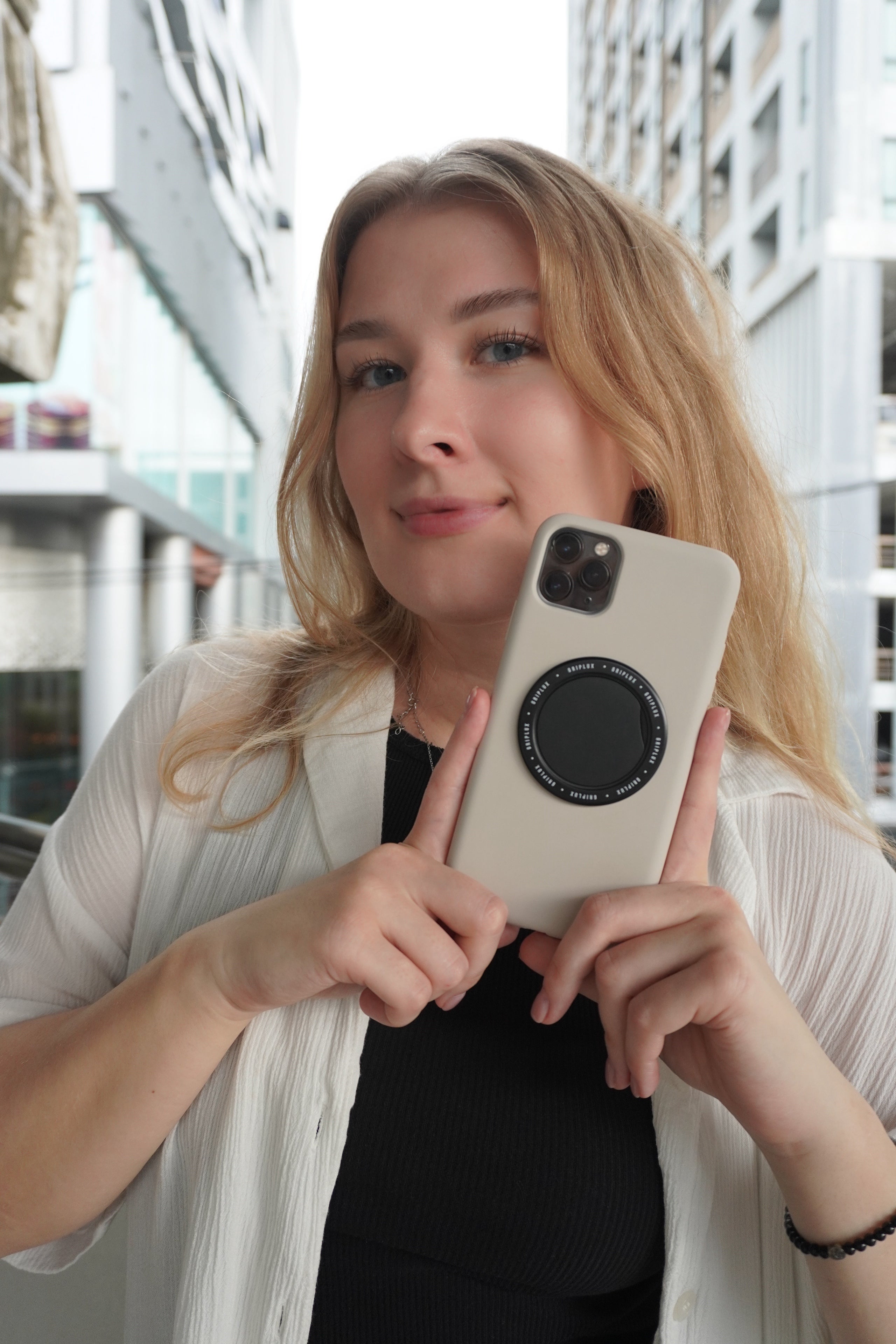
01Why a phone case causes flash glare in photos
When a phone case is causing flash glare in photos, the light is taking a shortcut. Instead of going out to the subject and back, some of it travels through the case material around the camera and lands directly on the lens. The result is a milky haze, low contrast, or a bright smear along one edge of the frame.
Clear plastic is very good at carrying light. That's how fiber optics work. A transparent raised lip that wraps around both the flash and the lenses behaves like a tiny light pipe: the flash fires into one side of the lip and the light comes out the other side, right next to the glass. Frosted and translucent rings scatter it, which can look even worse.
It's most visible in exactly the situations where you'd use flash: dark rooms, night shots, close-ups of menus and receipts. In daylight the flash is off, so most people only notice it at a party and blame the phone.
Phones with the flash sitting very close to the lenses, which covers most recent iPhones and many Android flagships, are the most sensitive. The shorter the gap, the less light has to travel through the case to reach the glass.
02The 30-second test
-
Clean the lenses first
Wipe the camera glass and any lens protector with a microfiber cloth. A fingerprint on the lens makes flash photos hazy on its own and fools the test.
-
Shoot a dark, flat subject
A dark wall or the inside of a closet, about an arm's length away. Turn the flash on, not Auto, so it fires every time.
-
Shoot again with the case off
Same spot, same distance. Compare the two side by side at full size.
-
If you use lens protectors, test those too
Case off, lens protector on, then both off. This tells you which layer is responsible.
If the haze appears only with the case on, read on. If it's still there with everything off, the cause is the lens itself (smudged, scratched or fogged) and no case will fix it.
03Usual suspects and how to fix each
| Cause | What you see | Fix |
|---|---|---|
| Clear raised camera lip | Even haze across the whole photo | Switch to a case with an opaque or dark-lined camera surround |
| Frosted or translucent camera ring | Glowing patch near one edge | Same as above; frosted rings scatter light more |
| Metallic or chrome camera trim | Bright streaks or reflections | Pick a matte finish around the cutout |
| Lens protector rings with gaps | Flare on one lens, often the one nearest the flash | Reseat it, or swap to a different style of protector |
| Dust or oil under a lens protector | Soft, foggy photos with or without flash | Remove, clean and reapply, or replace |
| Camera cutout too small | Dark corners, not glare | Wrong model case; check it's made for your phone |
If you love the case, a thin ring of matte black nail polish or black marker painted on the inside wall of a clear camera lip blocks most of the light path. It's not pretty up close, but it works until you replace the case.
04Lens protectors can cause the same glare
Individual lens rings sit right next to the flash. If a ring has a clear rim or isn't pressed fully down, flash light can leak in at its edge. A full-cover lens protector, one sheet over the whole camera area, can also reflect flash between the protector and the lens if dust or air is trapped underneath.
Neither type is bad by default; installation is what usually goes wrong. Our rings vs full-cover comparison covers the trade-offs, and camera blurry with a lens protector walks through cleaning and reseating one. If you're unsure whether you need one at all, see are camera lens protectors worth it.
05Do you even need the flash?
Often you don't. Modern phones combine several exposures in low light, and Night mode on iPhone (or Night Sight on Pixel and Night mode on Galaxy) usually gives more natural skin tones and backgrounds than a direct flash. The flash still earns its place for fast-moving subjects, backlit faces and reading small print, but switching it from Auto to Off fixes case glare instantly and often improves the photo.
- Dim restaurant or bar: flash off, hold still for the Night mode countdown.
- Kids or pets moving: flash on, and use a case that won't flare.
- Documents and receipts: flash on if there's no lamp, but tilt the page slightly to avoid a hot spot.
06What a flare-free case looks like
- Opaque material around the camera. Solid colors, aramid weaves and dark frosted backs don't pipe light.
- A clear case with a black or colored camera ring. Plenty of clear cases now add an opaque surround for this reason.
- A lip that sits just proud of the lenses. Enough to keep the glass off a table, not so tall that it shades the frame edges.
- A cutout that matches your exact model. Camera layouts change between generations even when the phone looks the same.
Solid and dark finishes around the lenses, so the flash goes out instead of sideways.


Set your phone in Find My Phone to see only cases cut for your camera layout.
Questions people ask
Why do my flash photos look hazy with my case on?
Flash light is traveling through the case material around the camera and hitting the lens directly. Clear and frosted camera lips are the most common cause. Test by taking the same flash photo with and without the case.
Do clear cases affect photo quality?
Without flash, a well-cut clear case has no effect. With flash, a clear lip that surrounds both the flash and the lenses can cause haze and lower contrast. Clear cases with an opaque ring around the camera avoid this.
Can a camera lens protector cause flash glare?
Yes. A lens ring that isn't fully seated, or dust and air under a full-cover protector, can let flash light bounce into the lens. Clean and reapply it, and test with it off to confirm.
How do I stop flash glare without a new case?
Turn the flash off and let Night mode or the phone's low-light processing handle dark scenes, which often looks better anyway. Or darken the inside of a clear camera lip with matte black paint or marker as a stopgap.
Does a phone case affect the camera without flash?
Only if it's the wrong model and the cutout blocks part of a lens, which shows up as dark corners. A correctly cut case has no effect on normal photos.